
Are documentaries movies?
Let's be real. We all kinda know they're not! But documentary's theatrical crisis might come from misunderstanding what people value about nonfiction in the first place.

I’ve been seeing more docs in movie theaters lately. I don’t mean there are more, overall (there are not); I just personally have seen a few more than usual on the big screen.
Partly this is because I went to some film fests — True/False, SXSW, and next weekend I’m going to DC/DOX — and also because I just hosted Q&As for three docs currently in theaters — We Are Pat, Underland, and Time and Water.
Those experiences, combined with all my recent obsessions: the nature of cinematic attention in an infinite content world, social media, marketing, how to understand audience expectations, the future of documentary — and having just dropped a trailer (700k+ organic, not-purchased views) for my own film going into theaters July 29 (opening wider in August)1 —
all of this makes me wonder…
Are documentaries movies?
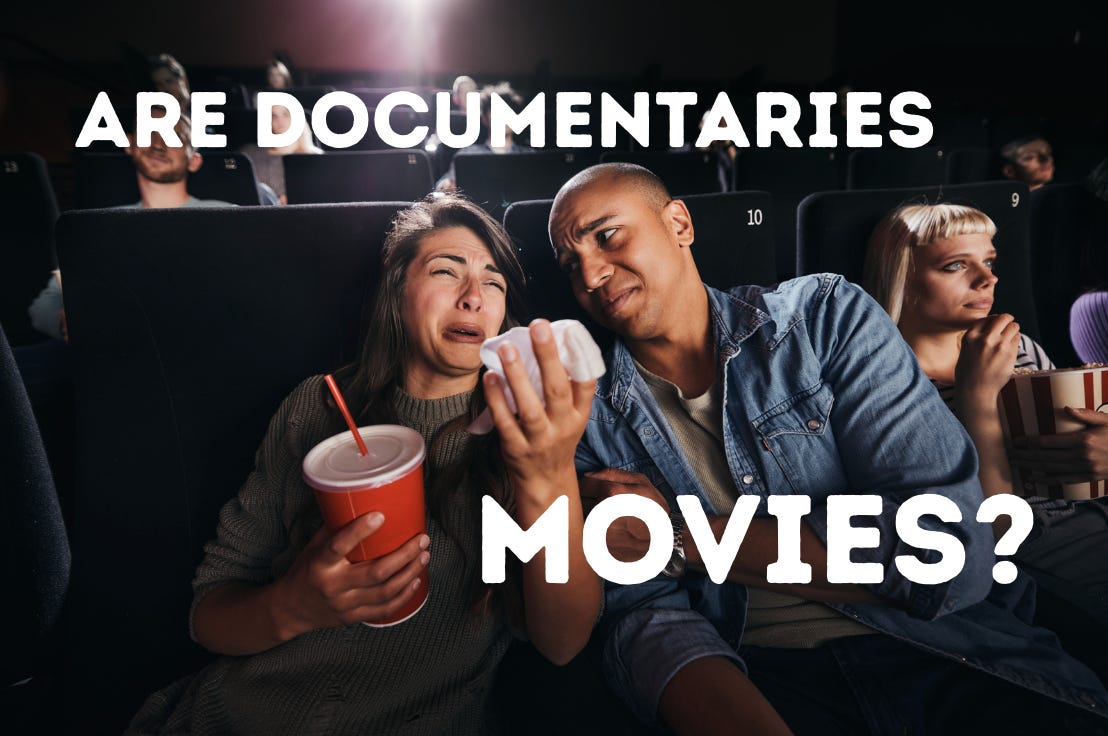
The question makes me laugh. But what do I even mean by asking it? Or, what would be at stake in trying to answer it?
Well, as someone releasing a doc theatrically, what I’m truly asking myself right now is why would someone go OUT TO THE MOVIES to see Wild Inside (or any other doc)?
Are documentaries even movies?
On the one hand, it’s a linguistic question. When someone says in the comments of my trailer, “This would make such a good movie!” I might joke about how they literally just watched a movie trailer, ha ha ha — but actually, we all know what they mean, which is that docs are not movies. We (mostly) do not turn to docs and movies for the same purpose, they (mostly) do not do the same things.
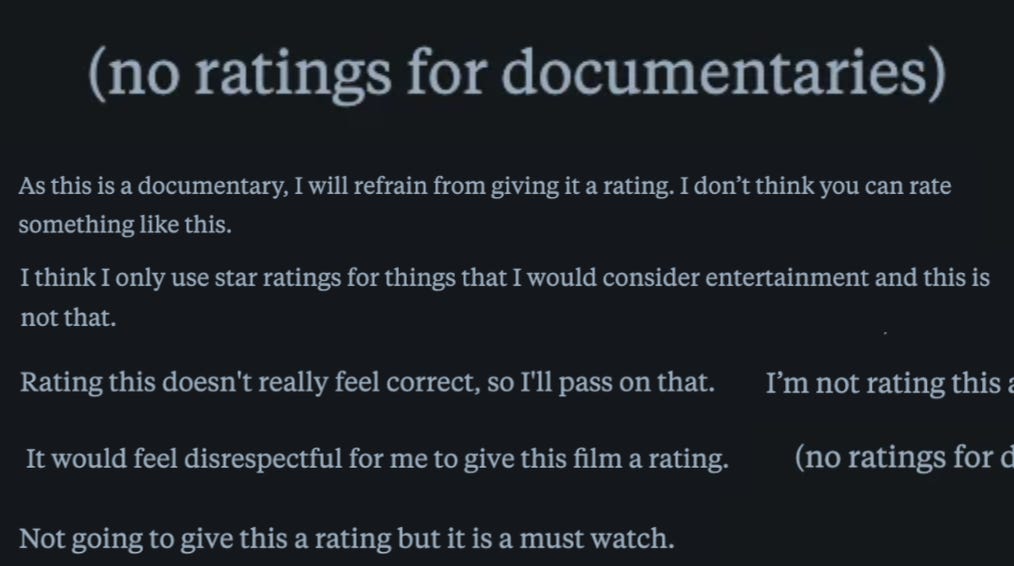
Another clue is that many people find the idea of rating documentaries distasteful, while they happily rate MOVIES all day long. Viewers and critics tend to judge the subject matter of a doc rather than the movie itself, and criticism can feel mean-spirited because documentaries are usually viewed NOT as movies, but as important social goods made by well-intentioned people doing difficult work for very little money.
Asking “are documentaries movies?” might also be a way of answering a question that’s been nagging at me pretty much every day since I saw this stat:
Overall movie theater attendance is down more than 50% since 2018, and ticket sales for documentaries are down more than 90%.
Where did that 2018 audience for theatrical docs go?
Granted, as the above stat acknowledges, all movies are having a tougher time at the movies… but a 90% drop???
If “documentary” is a genre, it is amongst the genres that are doing the absolute worst in theaters. Documentary currently is the opposite of horror when it comes to genres that people will leave their house, buy tickets, and stand in line for in 2026.
And I totally get it! Most people — including me — go to the movies to be transported out of their real lives. They want an escape from reality, not to be confronted with even more reality, especially when most docs are super f*cking depressing and also not terribly interested in providing anything so coarse as entertainment value (sorry / not sorry).
But escapism and entertainment isn’t the only thing we want at the movies. We also want events to attend with friends that feel meaningful and interesting. We want to learn new things and be part of cultural discourse. Docs can definitely form the basis of incredibly rewarding event screenings.
Essayist Philip Lopate once asked: “Why can’t nonfiction be nonfiction? Why does it have to tart itself up and be something else?”
Good question. Because the more I think about it, the less interested I am in proving that documentaries are movies. I’m more interested in figuring out what documentaries are.
After all…
Millions of people love and watch docs — even as they don’t think of them as movies. Sometimes, they even show up in person to see them! In theaters!
Maybe docs aren’t movies.
If that’s true, then as someone releasing a documentary in theaters this summer, I don’t find that depressing. I find it clarifying.
Because it means the challenge isn’t convincing audiences that Wild Inside is somehow secretly going to give you what a fiction film would. The challenge is understanding what people come to nonfiction for in the first place, and doing the best I can possibly do at delivering that, IN A MOVIE THEATER, knowing that almost all doc lovers are loving and watching docs at home.
For decades, documentary filmmakers have borrowed the language of fiction prestige. We praise docs for being cinematic. We celebrate them when they feel like thrillers, mysteries, comedies, adventures. And all of that is fine. It’s cool! I like it!! Go forth with all the sweeping drone shots and the cool music!!! Please try to make less boring, more entertaining docs, especially funny ones please for the love of god… Great!
But as Lopate points out, nonfiction already has something fiction doesn’t. It’s real, or it’s true, it’s set in the real world and it has real world consequences. That sounds obvious, but it’s the entire reason the form exists and it’s important to remember people turn to docs for that reason, and not necessarily because sometimes it “feels like fiction.”
So maybe the future of theatrical documentary is about learning how to build theatrical experiences around the thing that only nonfiction can provide.
This is what I’m trying to learn right now. I’ll let you know how it goes!
ARE YOU INTERESTED IN DEVELOPING YOUR DOC CONCEPT? Well, lucky you, because after I got such a good response to this piece, the good folks at Maine Media asked me to design an ONLINE WORKSHOP around it! Sign up here. Participants should bring an idea for a documentary, either one they’re already working on or a new idea, and we will workshop these as a group. Everyone will leave with an improved logline, and a more focused concept for their film.
Booking more cities every day now, so now’s the time to give a shout if you want me to try to show it at your local theater!!!
Hi Penny, I've been arguing that documentaries can be movies a lot over the last decade (whether in teaching a class called "The Art of Documentary" or in curating docs for film festivals.) Of course, not ALL documentaries are movies, but movies can also be documentaries. I think you're playing into some of the old haggard and false stereotypes about docs in positing this as a question. (Yes, unfortunately, the industry does this, too, but I think we're well past these old formulations and we should stop repeating them.) To say that documentaries are "cinematic" isn't to borrow from fiction filmmaking--docs have always borrowed from fiction as fiction has from docs, from the beginning of cinema. Look at the Lumiere Bros! Vertov! Eisenstein! Marker! Varda! Morris! Oppenheimer! Fiction and nonfiction have always fed each other. As Godard famously said, "If you want to make a documentary you should automatically go to the fiction, and if you want to nourish your fiction you have to come back to reality"!
Love the provocation, and it feeds right into a "secret" admission I've made to a few friends recently: I never watch docs in theaters. Ok, maybe not NEVER, but very rarely -- basically to catch up on awards nominees I feel would be better seen in a cinema. But that's way fewer than I could...
BUT! I do watch a TON of docs at film festivals. And that's really fun! Know why? The theater is packed, typically the filmmaker's there for a q&a, and, unfairly to my local cineplex, I'll likely know at least a handful of people in the room. It's a total community vibe.
So the question *I've* been asking is: How do we expand THAT? In a way that's scalable and sustainable? Though I'm not usually in attendance at them, filmmakers I know love community screenings. Is a doc with a robust community screening tour a movie or not? I dunno, but maybe that's less of an issue if the experience is that rewarding.